


Weston at Work Chapter 6 of 8
Wire Town: Gilbert & Bennett and Swedetown
How did a sieve-maker's experiment bring Swedish families to Weston?
Where Weston, Wilton and Redding meet, a wire mill grew from one experiment with a borrowed loom, and drew families from Sweden.
From horsehair to wire
Sieves were woven from horsehair, and they wore out. In 1834 a Georgetown sieve-maker named Gilbert tried something new. As the company's own booklet tells it:
“Some fine iron wire was obtained, a neighbor's carpet loom borrowed and on it was woven the FIRST Wire Sieve. In that experiment to improve sieve making lay the germ of a great industry — The FIRST Woven Wire Cloth to be made in America.”
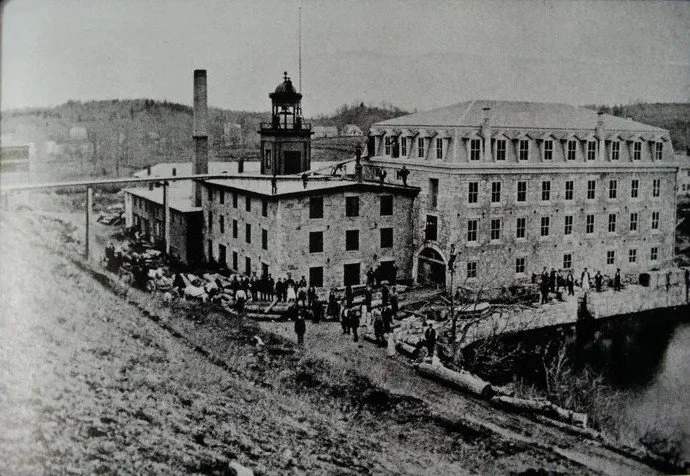
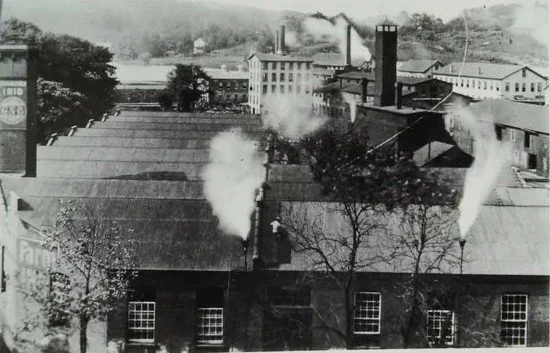
The booklet says the wire probably came from Worcester, Massachusetts, where Ichabod Washburn and Ben Goddard had begun drawing iron wire by a continuous process in 1831. From that loom grew the Gilbert & Bennett Manufacturing Company. In a photograph of about 1910 the mill's chimney is lettered “1818 G&B”, perhaps the year the business began.


A mill village on three towns' line
The atlas shows Gilbert, Bennett & Co.'s sawmill, glue factory and sieve factory around their mill pond on the Norwalk River, a wire factory downstream, and the Danbury & Norwalk Rail Road running through the village. The lines between Redding, Weston and Wilton meet close by.
What was it for?
Gilbert & Bennett sold its wire goods across the country, with stores as far away as Chicago. Guess what each was for, then turn it over.
-
Ash sifters
For saving the unburned coal from the stove's ashes. “Most often a chore of one of the boys in the family.”
-
Ox muzzles
Wire baskets that kept a working ox from grazing in the furrow.
-
Web wire fence
Galvanized fencing “for farm and railroad fencing”.
-
Coal hods
The “Oriental” funnel coal hod, for carrying coal to the stove.
-
Traps
Rat traps, mouse traps and “balloon” fly traps.
-
Flower-pot stands
Wire stands to hold pots of plants.


Swedetown
Around 1900 a large group of Scandinavian immigrants, nearly all working at the wire mill, made a community in Weston known as Swedetown, with its own Swedish Covenant church.
Gertrude (Peterson) Johnson was born on 2 January 1911 at “Jaderlund Corners in ‘Swedetown’”, in the Georgetown section of Weston. Her grandfather August Peterson had come from Sweden late in the 1800s and “worked in the Gilbert and Bennett wire mill”. Her husband, Vernon Johnson, “spent many years working at the Gilbert and Bennett wire mill” too.
From “A Walk Along Georgetown Road”, by Lynne Barrelle and Karin Giannitti, 1999.
Lecture: “Immigration & the Mill: A Look at Swedetown”, by Samantha Fargione, the Center's former executive director.
On History From Home →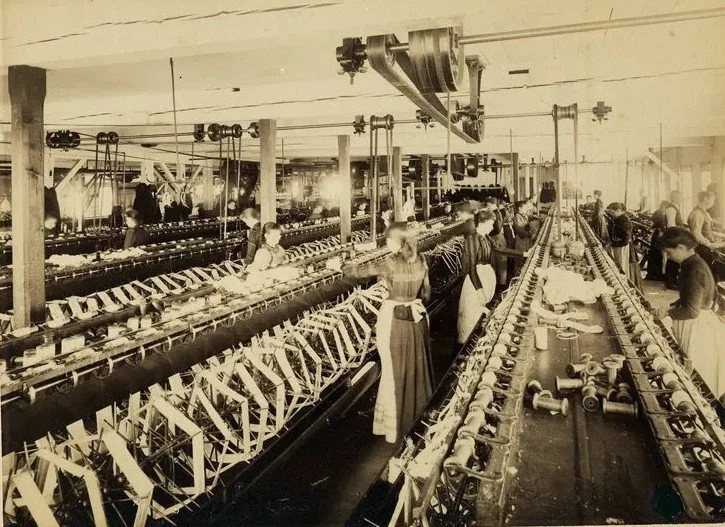
Silk thread
The raw silk winding room of M. Heminway & Sons, about 1900–15, one of a series of photographs of women and children at work in the mill. Why are they in Weston at Work's files? Do you know?
Waiting for you in the Coley Barn
- The panels on the immigrant community around the wire mill
- Carding wool, and weaving at the community wall loom: Gilbert wove his first wire sieve on a borrowed carpet loom
Open Thursdays and the first and last Sundays of the month, 1–4 pm. $5 adults, $3 ages 5–17; under 5 and members free.
Plan your visit →Help
Help us find out
Many of the photographs here raise questions: who is this, where was that mill? If you know, or would like to help research, tell us.