

Online exhibit
The Fraser Panels
Laura Gardin Fraser's history of America in bronze, from West Point to Weston.
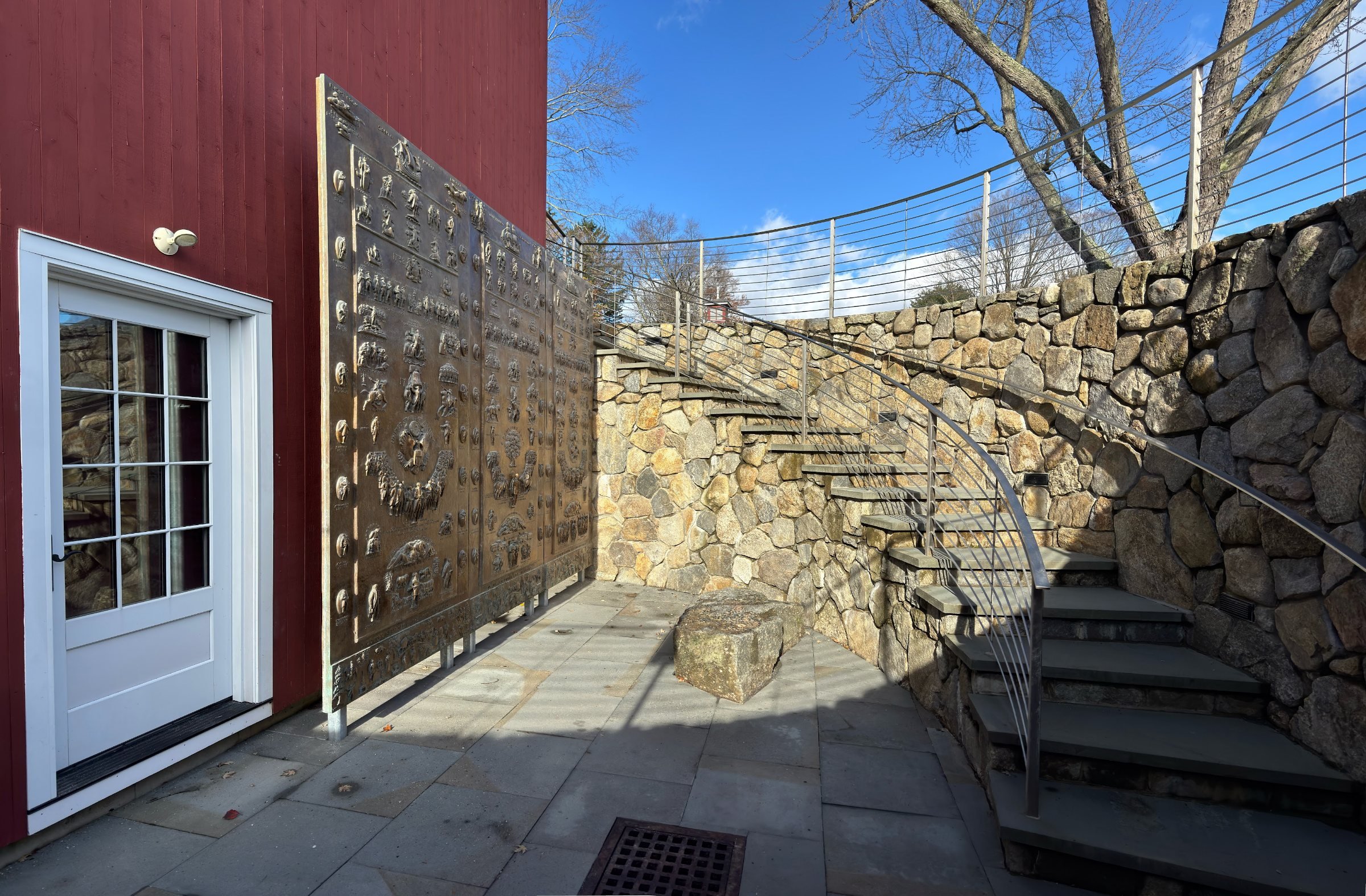
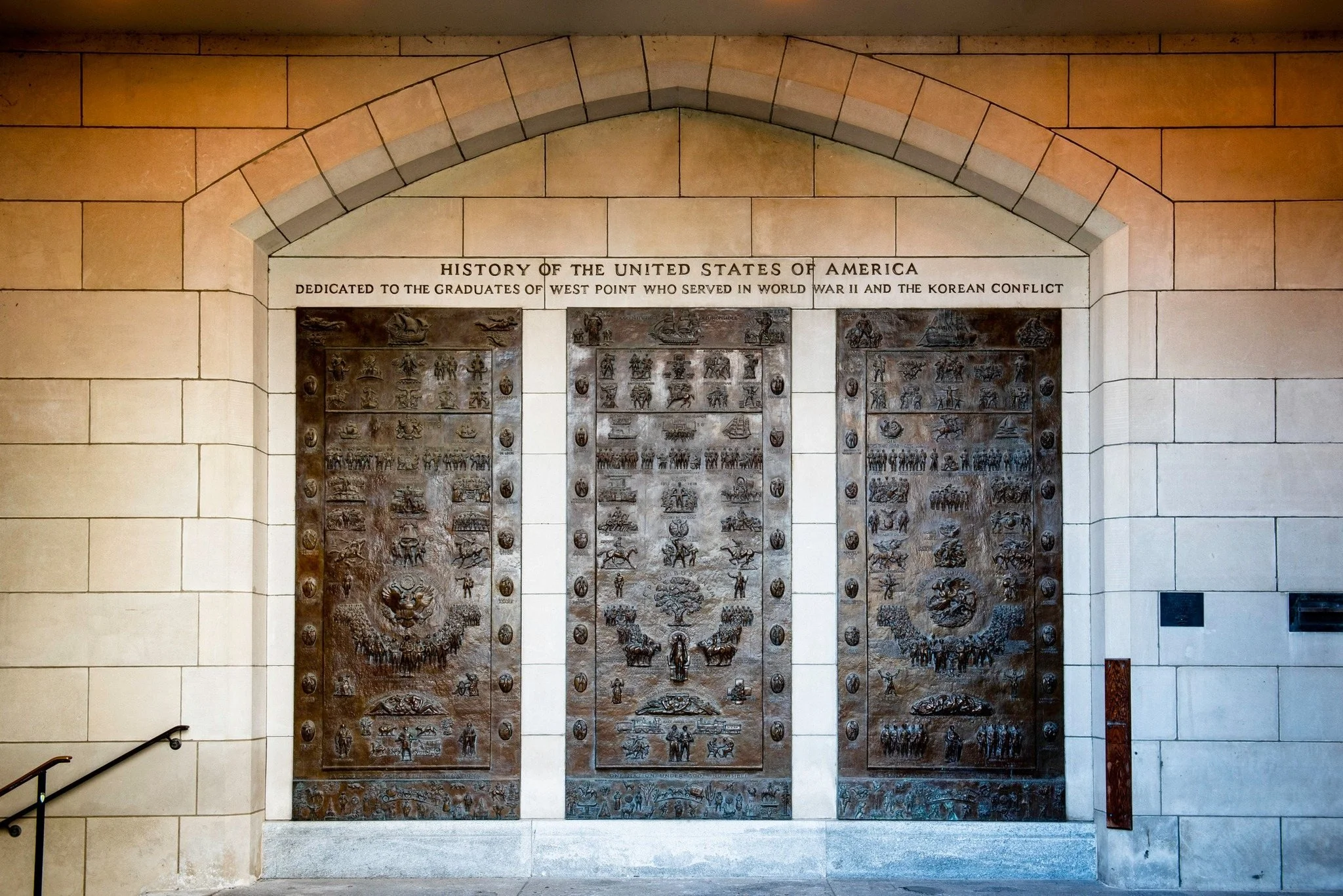
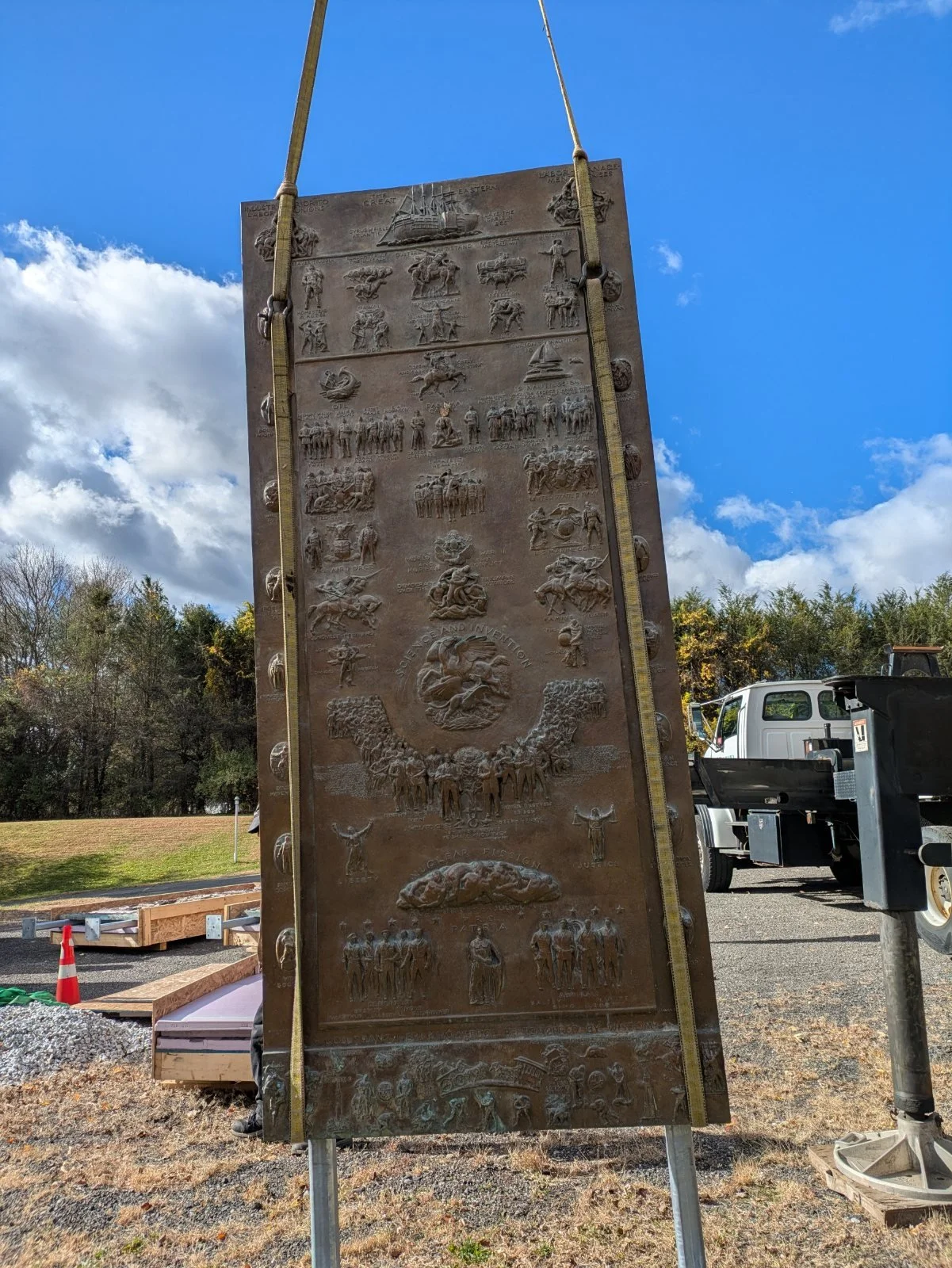
Three bronze panels, each more than ten feet tall, tell the story of the United States in about 150 small scenes, from Leif Ericson's landing to the atomic age.
The sculptor Laura Gardin Fraser, who lived and worked on the Westport–Weston line, spent years modeling them. They were dedicated at the United States Military Academy at West Point on June 3, 1965, to the academy's graduates who served in World War II and the Korean War. In 2025 they came to Weston, and they now stand in the stairwell of the Visitor Center.
Up close the panels read like the pages of a picture book: explorers' ships along the top, colonists, soldiers, inventors and writers in rows down the middle, a great symbol at the center of each, and the plants and animals of the land along the bottom.
- Panels
- 3, cast in bronze by the lost-wax process
- Each panel
- 10 ft 7 in tall, 4 ft 8 in wide
- Weight
- About 1,250 pounds each
- Scenes
- About 150, numbered in the sculptor's own key
A sketchbook in clay
The panels began as Fraser's own project, years before anyone commissioned them. She explained:
"As far back as 1935 .... it was rare to come upon anyone who had a real knowledge of American history or an appreciation of our heritage. Being one of these myself, the realization started a train of thought that became a dominant force. By intensive reading and research, I began to make small sketches in clay, in between 'jobs' of larger form, depicting historical incidents or persons .... Eventually, these sketches in clay became so numerous, like the leaves of an unbound book, that I patterned them onto large panel backgrounds."
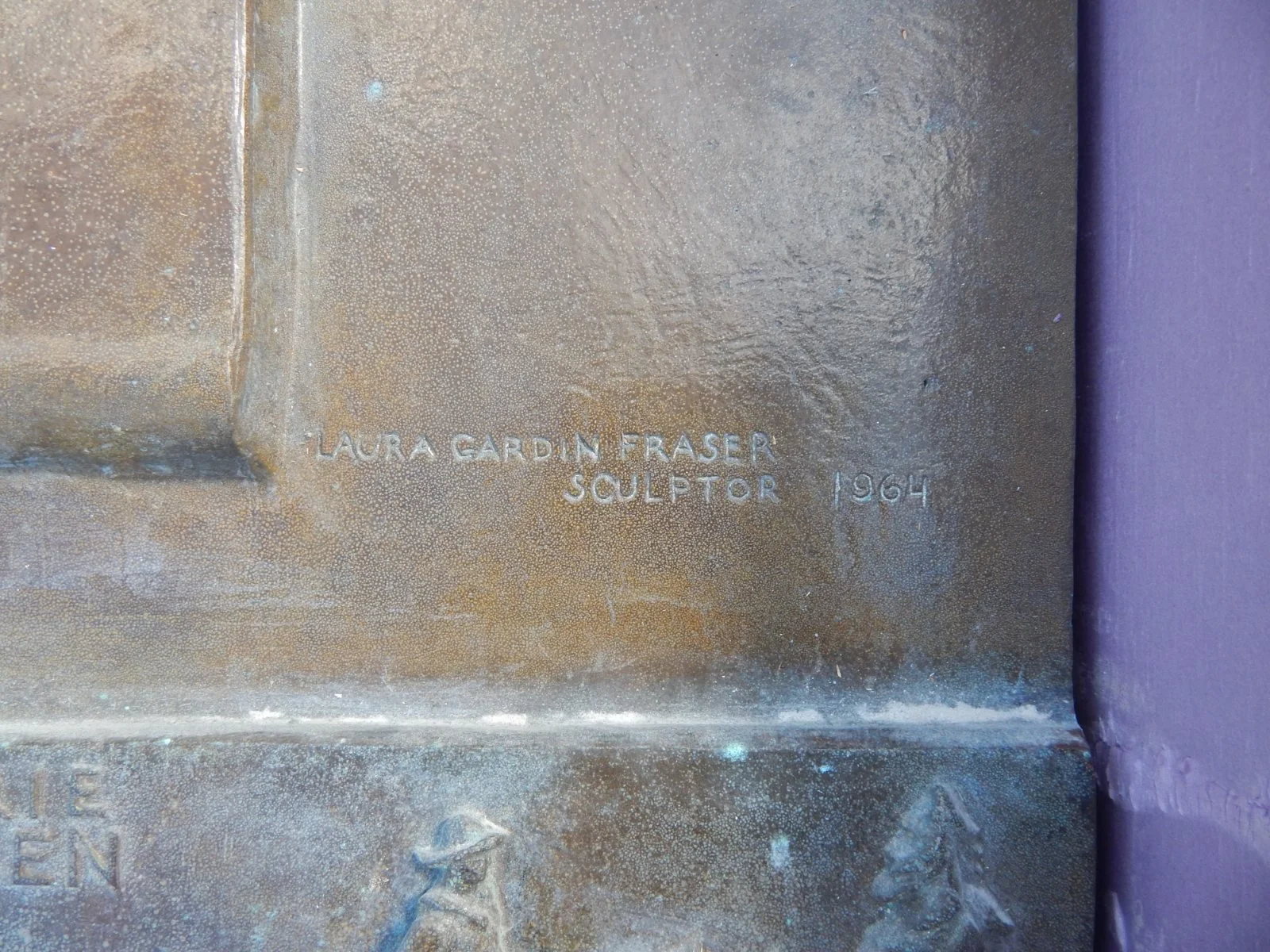
In 1951 Brigadier General L. E. Schick, a West Point professor, saw the unfinished work in her studio. He remembered it when the academy was planning a new library, and noticed how many of the people in it were West Point graduates. With the approval of the superintendent, Major General William C. Westmoreland, Fraser was asked to finish the panels for the library's entrance. The bronzes are signed "Laura Gardin Fraser, Sculptor, 1964," and were dedicated the following June.
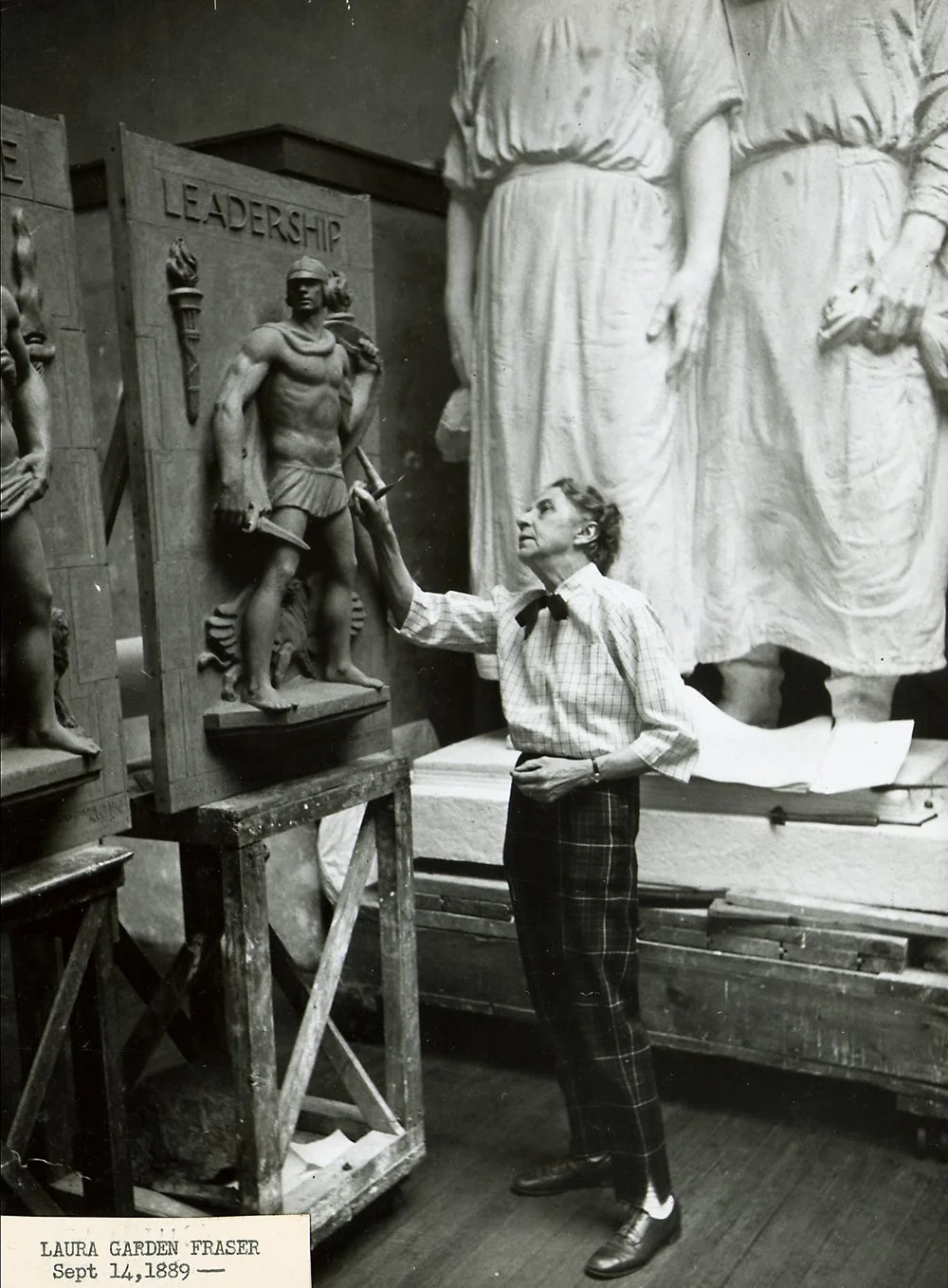
1889–1966
The sculptor next door
Laura Gardin Fraser was one of the leading American sculptors of medals and coins. She married the sculptor James Earle Fraser, maker of the Buffalo nickel and End of the Trail, and the two worked side by side for decades. Their home and studio were off North Avenue, on the Westport–Weston line, and they were part of the circle of artists who made this corner of Fairfield County their home in the first half of the twentieth century.
She was among the first women to design coins for the United States. Her commemorative half dollars include the 1921 Alabama Centennial, the 1922 Grant Memorial and, with her husband, the 1926 Oregon Trail Memorial. Her 1931 design for a George Washington quarter won the competition but was passed over; it was finally used for the 1999 commemorative five-dollar gold coin, and from 2022 on the front of every new quarter.
She also made large sculpture: the Pegasus at Brookgreen Gardens in South Carolina, the reclining elks at the Elks National Veterans Memorial in Chicago, and, at West Point, the medal for the academy's sesquicentennial, the Thayer Award medal, and these panels. Her work is in the collections of the Metropolitan Museum of Art, the Brooklyn Museum, the British Museum and the Art Institute of Chicago.
The full-size plaster models from which the bronzes were cast have hung in Weston Town Hall for many years. With the bronzes now at the Center, Weston is home to both.
Read the panels
Each panel follows the same plan. Read it from left to right, top to bottom. Fraser numbered every scene and wrote a key, published by West Point's Department of Military Art and Engineering. She was clear that the people shown are "representative figures of their times," chosen to tell the story of each period, not memorials to them.
-
01 · Left panel
A Goodly Heritage of the Host of Nations
About 1000 to the early 1800s
From Leif Ericson and Columbus to the crossing of the Appalachians. At the center is the Great Seal of the United States, "our genesis as an independent nation," above the signers of the Declaration and the Constitution grouped around Washington.
Look for: the Mayflower and the Santa Maria · Henry Hudson's Half Moon · Paul Revere · Molly Pitcher at Monmouth · Franklin and his kite · Daniel Boone
-
02 · Center panel
One Nation, Under God, Indivisible
The early 1800s to 1869
The young nation grows, divides and holds together, ending with East and West joined by the railroad at Promontory, Utah, in 1869. At the center is an oak, the Tree of Liberty, standing for "a single union which Lincoln was determined it must remain," with the armies of the South on his left and the North on his right.
Look for: Lewis and Clark with Sacagawea · the frigate Constitution · Francis Scott Key at Fort McHenry · the Erie Canal · the Pony Express · Clara Barton · Sylvanus Thayer, "Father of the Military Academy"
-
03 · Right panel
God Grant New Knowledge be Tempered by Wisdom
The late 1800s to the 1950s
Industry and labor, the West, two world wars and Korea, and the atomic age. At the center a griffin, guardian of earth, air, fire and water, plays with Pegasus, the spirit of imagination, surrounded by scientists and inventors; below is an image of nuclear fission. The bottom row is "a tribute to the workers of all professions" and "a plea for the conservation of the nation's natural resources."
Look for: the Wright brothers · Edison and Bell · Lindbergh's Spirit of St. Louis · Jonas Salk · Einstein · Susan B. Anthony · the Panama Canal
Find Connecticut
Connecticut people and stories turn up all over the panels. See how many you can find on your visit.
- The Charter OakLeft panel. Joseph Wadsworth hides Connecticut's royal charter in the oak at Hartford, 1687.
- Israel PutnamLeft panel. He rides his horse down a flight of steep steps in Greenwich to escape the British, 1779.
- Nathan HaleLeft panel. The Coventry schoolteacher, hanged as a spy in 1776, "regretted that he had but one life to give for his country."
- Roger ShermanLeft panel. The New Haven signer of both the Declaration of Independence and the Constitution.
- Eli WhitneyLeft panel. Inventor of the cotton gin, who made muskets with interchangeable parts in Hamden.
- Uncle Tom's CabinCenter panel. Harriet Beecher Stowe, born in Litchfield, published it in 1852.
- David BushnellRight panel. The Saybrook inventor of the Turtle, the first submarine used in war, 1776.
- Samuel ColtRight panel. The Hartford maker of the revolver.
- Charles GoodyearRight panel. Born in New Haven; he discovered how to vulcanize rubber.
Hard history in bronze
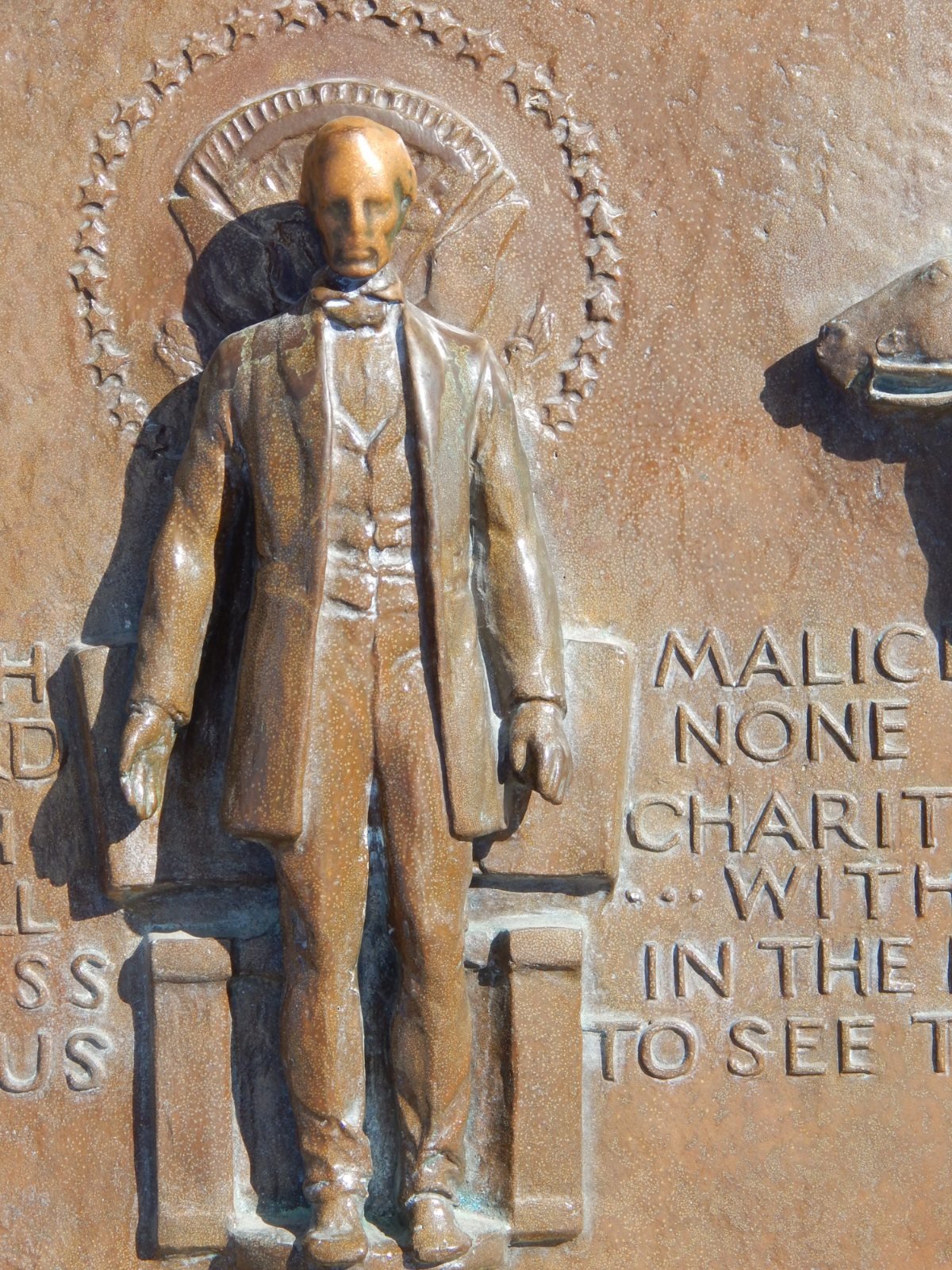
Fraser set out to show the whole story, including its worst chapters. The center panel shows plantation slavery, the Dred Scott decision, John Brown and William Lloyd Garrison's antislavery newspaper, Confederate as well as Union generals, and a hooded figure labeled "Ku Klux Klan." The words of her key, written in the 1960s, are of their time, and some read differently today.
In 2022 the congressional Naming Commission, set up to find names and symbols honoring the Confederacy on military property, reviewed West Point. Its report pointed to the Klan figure and recommended removing the images and names of Confederate leaders from the panels. That December the academy took the panels down and put them into storage.
Rather than cut the work apart, the academy looked for a new home for it, and found one in Weston. As the sculptor's guide says, the people shown are representative figures of their times, not memorials. Seen whole, the panels let visitors look at both the triumphs and the tragedies of American history, and at how our view of that history has changed since 1965.
From West Point to Weston
When West Point took the panels down in December 2022, it did not want them cut apart or destroyed. The academy decided to deaccession the work, releasing it from its collection, and began looking for a new home where it could be seen whole.
Why Weston
West Point approached the Weston History & Culture Center for two reasons. Laura Gardin Fraser had lived and made her art here, on the Westport–Weston line. And the Town of Weston already owned the full-size plaster models from which the bronzes were cast, which have hung in Town Hall for many years. In Weston the bronzes could be reunited with their models, a few miles from the studio where Fraser made them.
The Center agreed to take them, knowing the hard history they carry. In its view the panels' painful images record how Americans told their own story in the 1960s, without condoning what they show, and kept whole and explained, they offer what its board called a "teachable opportunity." In 2024 the Military Academy donated all three panels to the Center, and they now belong to it.
The move and the wait
Moving them was a project in itself. Each panel weighs about 1,250 pounds. At West Point they hung from steel tabs welded to their backs, about ten to a panel, bolted to brackets on a brick wall, with the stone facing of their alcove built around them. Freed from the wall, each panel was packed in its own wooden crate more than eleven feet long, on timber skids, and the panels went into storage while the Center prepared a place for them.
The Center raised money from its supporters for the rest of the work: conserving the bronzes, a support structure designed by a structural engineer to carry their weight and stand up to the wind, the installation, and the research behind this exhibit. The place chosen was the outside wall of the Visitor Center's lower level, where the stairwell becomes an open-air gallery and visitors can come close enough to read every scene.
Installation day
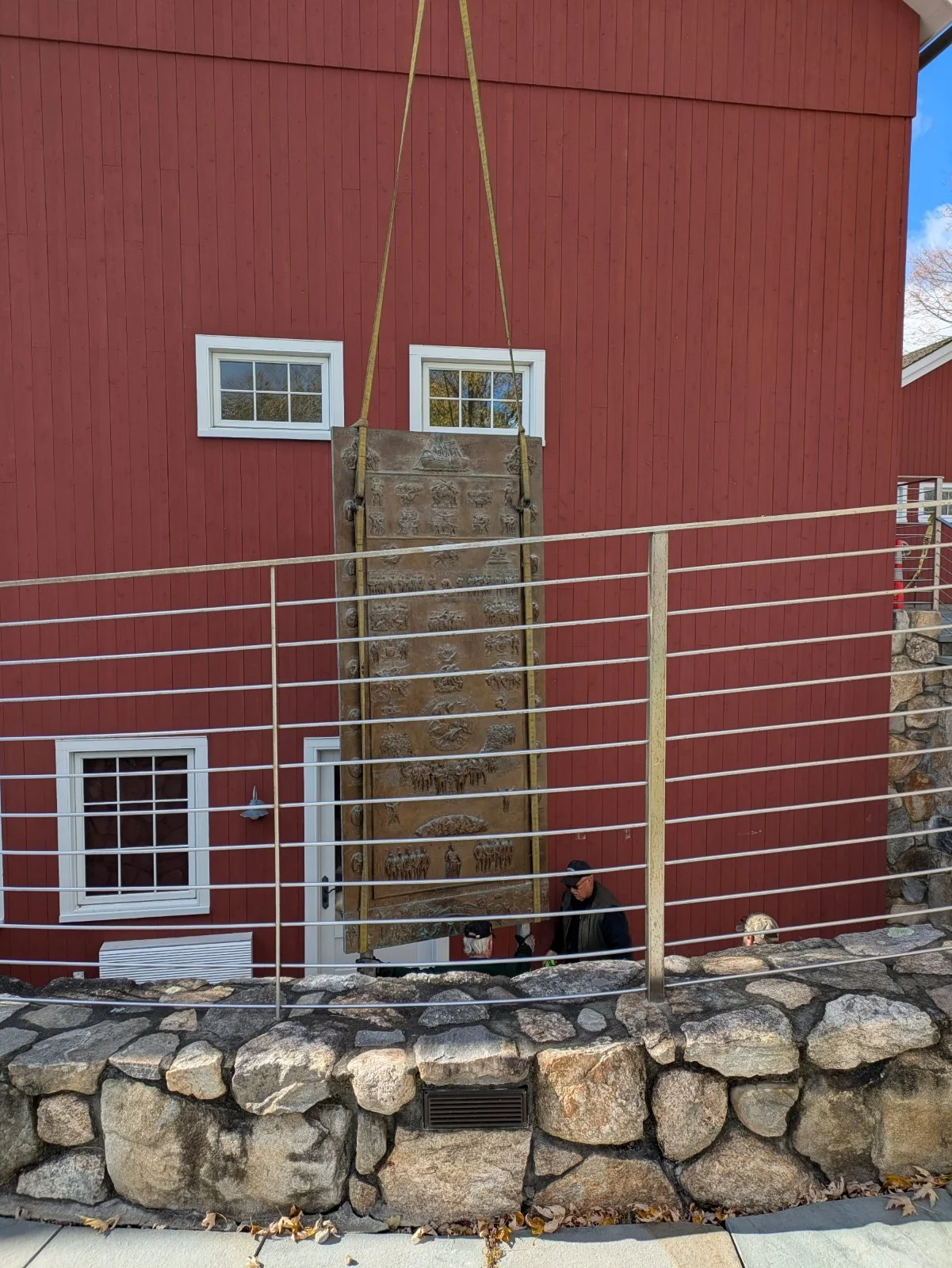
On November 6, 2025, a crane lifted each panel on straps, swung it over the stone wall and lowered it onto its new mount in the stairwell. Sixty years after their dedication at West Point, the bronzes and the plaster models they were cast from are in the same town, close to where Fraser first modeled them in clay.
Timeline
- 1935Fraser begins modeling small scenes of American history in clay.
- 1951General Schick sees the unfinished work in her studio.
- 1964The finished bronzes are signed and dated.
- June 3, 1965The panels are dedicated at the entrance to the West Point library.
- 2022The Naming Commission reports; in December the academy removes the panels to storage.
- 2024At West Point's invitation, the Center accepts the panels as a gift from the Military Academy. They are crated and put into storage.
- 2024–2025The Center raises funds for conservation, a new mount and the panels' interpretation.
- November 6, 2025A crane lowers the panels, more than half a ton each, onto their new mounts in the stairwell of the Visitor Center.
Sources
- History Panels, a guide to the panels with the sculptor's numbered key, prepared by the Department of Military Art and Engineering, United States Military Academy Library. Fraser's words and the descriptions of the panels are quoted from it.
- The Center's records of the gift, the move and the installation, and its Fraser Panels fundraising appeal, 2024–2025.
- News reports of the Naming Commission's findings, August 2022, and of the panels' removal, December 2022.
Photographs: Laura Gardin Fraser in her studio, U.S. Capitol collection (Flickr); the panels at West Point, from the Center's files; the close-ups, the installation and the panels in the stairwell were taken for the Center, 2024–2025.