


Weston at Work Chapter 7 of 8
Cloth
Where did Weston's clothes come from?
From the farm's own sheep to cloth by the yard, a rug loom that kept a family going, and sweaters for soldiers: a hundred years of Weston's textile work, much of it by women.
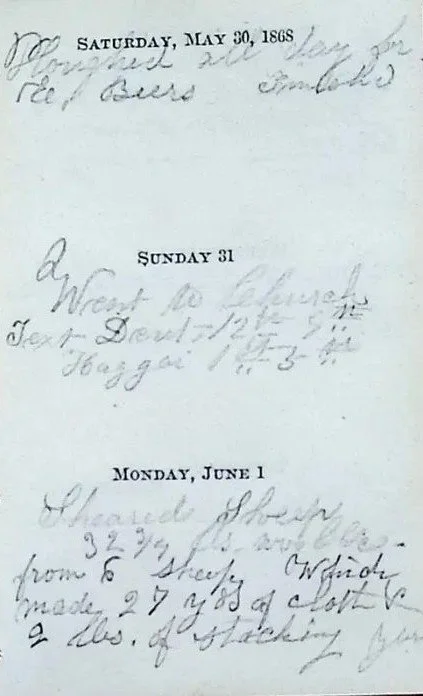
Six sheep, 27 yards
“Sheared sheep. 32¾ lbs. … from 6 sheep which made 27 yds of cloth & 2 lbs. of stocking yarn.”
In 1868 a Weston farm could still turn its own wool into cloth for the household.
Cloth by the yard
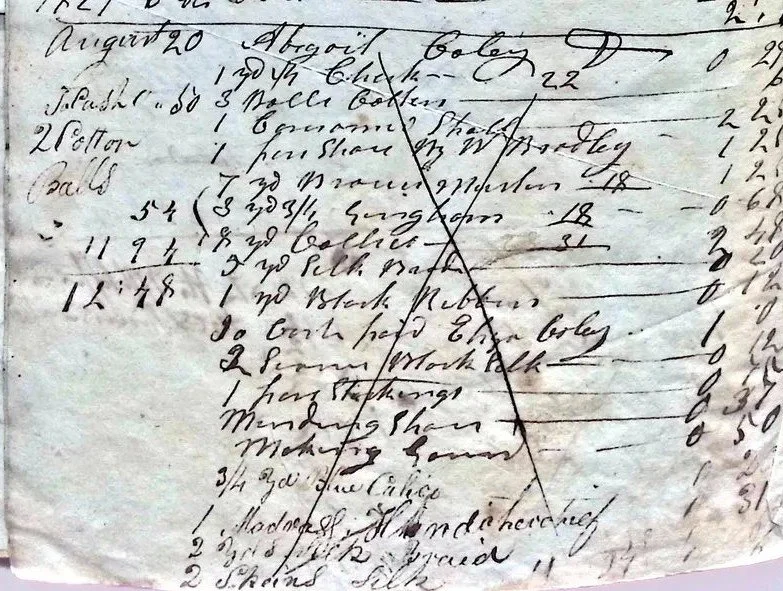
Forty years earlier, Weston families bought their cloth. A Coley store ledger of 1826–1830 records what they took home by the yard:
- muslin
- calico
- gingham
- broadcloth
- flannel
- fustian
- bombazet
- satinet
- brown shirting
- linen
They bought thread (“skeins of silk”, “cotton balls”), buttons by the dozen, and indigo to dye with. Sometimes they paid the store for “making gown” or “making shirt”: the store sold sewing as well as cloth.
The Town of Weston kept an account too, to clothe residents who couldn't clothe themselves. On 20 April 1828 it paid for “3 yards brown shirting for Betty Wells, 6¾ yards gingham for Wells”, and “3 yards of brown shirting for Cuff”. Later entries add a shirt made up for him and “1 pair of shoes for Cuff”.


Weston History & Culture Center.
A ball of rags, a rug
The working loom in the Coley Barn kept a farm going. It was the main source of income for a widowed mother of four.
On 17 September 1931 Leroy Lockwood, a farmer and sawmill operator on Georgetown Road, was killed by an electric shock as he tried to shut off the current during a cellar fire at his home. He was 53. He left his wife, Elsie, and four children, the eldest fourteen.
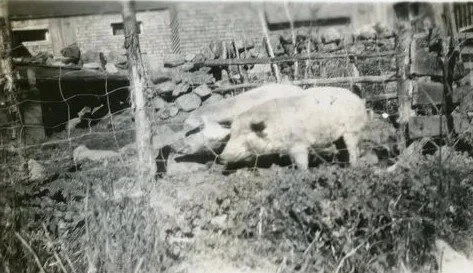
Elsie kept the farm. She raised pigs and kept hens and cows, and she wove rag rugs to sell on a Reed Manufacturing Company “Weavers' Friend” loom. Her own note says where it came from:
“Elsie […] Lockwood bought this loom from Cong. Church parsonage (Norfield) – Reverend Moses' wife used to weave.”
Elsie's numbers
- ball of cut and sewn rags for one rug
- the size of a rug
- from one warp, wound “11 spaces… 30 times around”
Her log for 1953 records about a dozen rugs between 20 July and 1 August: “wine & gray”, “hit & miss stripe”, “linen rug”, “cotton stripe”, “runner”.



“Throw scrap into fight”
In the war Weston's women knitted and sewed for the Red Cross and the Thimble Club, and the Norwalk Hour reported it:
- December 1941
“There is still need for women to knit adult-sized sweaters.”
- January 1942
The Red Cross asks knitters to return their surplus wool, “in order that the high production rate may be maintained.”
- January 1942
The Thimble Club “adopted” a soldier “because he has no one to send gifts to him.”
- August 1942
Sewing meetings on Wednesdays at Town Hall: “join the group on the green in front of the Town Hall.”

Waiting for you in the Coley Barn
- The working loom, which visitors can try
- Carding wool, and weaving at the community wall loom
- The Textiles panel and the wartime “Throw Your Scrap Into the Fight” panel
- The “Put the Washing Out” activity
Open Thursdays and the first and last Sundays of the month, 1–4 pm. $5 adults, $3 ages 5–17; under 5 and members free.
Plan your visit →Help
Help at the hands-on stations
Children card wool, weave and haul a hay bale in the barn. On open days those stations need friendly helpers.