

A Weston story · December 7, 1882
The Night the Coley Barns Burned
A winter fire, a family’s memory and the barn that rose in its place.
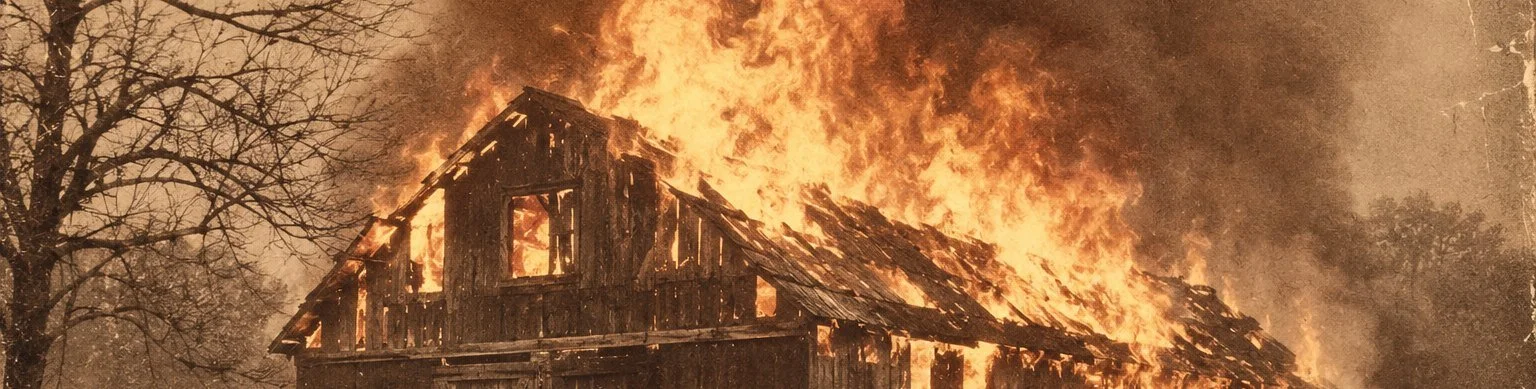
Illustration, no image of the fire is known.
On a Thursday evening in December 1882, both of the Coley family’s big barns on Weston Road burned to the ground.
The hay, the tools and many of the animals went with them. A newspaper called the fire deliberately set; the family remembered it differently, and never forgot it. The next year new barns went up in their place, and one of them is the Coley Barn that holds the Weston at Work exhibit today.
This page brings together everything the Center has found about that night: a newspaper report, a family letter, the memories handed down in the Coley House and the clues in the barn itself.
- When
- Thursday, December 7, 1882, about half past seven in the evening
- Where
- The Coley farm, today the Weston History & Culture Center, 104 Weston Road
- Lost
- Two barns, about forty tons of hay, farm tools and livestock
- Rebuilt
- 1883: the Coley Barn, home of Weston at Work
December 7, 1882
A bright light in the northeast
The fire was seen from Norwalk. On the following Tuesday the Norwalk Gazette told its readers about the glow in the sky to the northeast, and how their firemen had set out toward it, then turned back when they found it was beyond their reach.
It was the Coley farm in Weston. By the time anyone could have got there, nothing was left to save.
Norwalk Gazette
December 12, 1882
“About half-past seven on Thursday evening, our citizens were startled by a bright light in the Northeast giving an indication of a large fire in the near vicinity. The fire laddies were out in force but after proceeding a short distance found that the fire was beyond their limits. It proved to be two large barns in Weston owned by Demon (sic) Coley. They were totally consumed together with about forty tons of hay, a lot of farming utensils, one fine horse, two cows, twelve sheep, two yearlings and several pigs. The fire was undoubtedly of incendiary origin.”
As transcribed in The Chronicle, Winter–Spring 1997. “Demon” is the Gazette’s spelling of Dimon: David Dimon Coley, then 71, who had built up the farm. “Thursday evening” in a paper of Tuesday, December 12, puts the fire on December 7.
“Incendiary origin” meant the fire was set, by accident or on purpose. The paper named no one, and no later report of a culprit has been found.
Norwalk Gazette
January 2, 1883
“Mrs. D. D. Coley is building two new barns to replace those recently destroyed by fire.”
Two children watching
What the family remembered
Two of David Dimon Coley’s grandchildren saw it: Ida Coley, who was 14, and her brother James, 12. Their father, James Lewis Coley, had died in 1870, when they were small.
Ida remembered the horses. Guides in the Coley House still tell what she recalled: hearing the horses neighing, and watching the barn burn with her brother, frightened.
A century later her son, John Coleburn, wrote down what his mother had told him. In the family’s version, farmhands sleeping in the barn set it alight, and it burned with the horses inside:


“They managed to get a couple of them out, only to have them break loose & dash back into the burning barn. My mother … used to tell me that for years she had nightmares, hearing the screams of the horses.”John Coleburn, Ida Coley’s son, letter of 1985
Her brother James never lost his fear of fire. About 1910, when the farm was his, he pulled down the great stone chimney at the heart of the house, which fed three fireplaces, and he never left the smokehouse fire burning overnight. The dining room’s false mantel and a join in the hall floor still show where the chimney stood. Meet the Coley family →
1883 to today
The barn that rose in its place
The new barn of 1883 was built in the English style found all over New England, with its main doors on both sides of the building, directly across from one another. In 2000 Ted Lockwood walked the Society’s trustees around the grounds and read the barn for them.
The doors are twelve feet apart, he showed, and the barn is built in twelve-foot sections, as English barns were; with wooden pegs and few nails, about 26 feet was as deep as a barn could go without posts in the middle. Hay was stored on the right side, with bins for feeding and straw for bedding. Between the open doors was the threshing floor, where grain was beaten and the hulls thrown up so the wind blowing through could carry the chaff away. A fine stone ramp leads up to the barn door, and the old barn probably stood on these same stones.


The barn served the Coleys for eighty years: onions, then milking cows, sheep and pigs, and later Jim Coley’s prize oxen and show cows. In 1963 Jim Coley gave the barn to the Weston Historical Society, and in 1981 his widow Cleora left the Society the house, the outbuildings and 3.7 acres.
Today the Coley Barn is home to Weston at Work, the Center’s exhibit on farming, mills and making things in Weston, with a hay press, a cider mill and a loom inside the barn that replaced the one lost in 1882.
1997
A century later: was there ever a fire?
The Chronicle from Winter–Spring 1997 wrote that in the 1990s Herb Day, the Coley House historian and barn curator, began to doubt the story. He could find no burnt or charred wood anywhere in the barn. And he had come across an account of another barn, belonging to a Mrs. Betsy Coley, burning at about the same time. Perhaps the family had mixed the two up?
Then he found the Norwalk Gazette’s two reports, which settled it: the Coley barns had burned. There was no charred timber because the old barns had been totally consumed, and the barn that stands today was built new.
Herb said he would keep looking into Mrs. Betsy Coley’s barn. Read the Chronicle story →
Open questions
Do you know more?
Some of this story is still a puzzle. If you know anything, from family papers, old newspapers or stories handed down, the Center would like to hear from you.
Still unanswered
- Who was “Mrs. D. D. Coley”, who built the new barns in 1883? David Dimon Coley’s wife Mary had died in 1872.
- Who or what started the fire? The Gazette said it was set; the family blamed farmhands sleeping in the barn.
- Who was Mrs. Betsy Coley, and was her barn’s fire the same night or another?
- Are there photographs of the Coley farm before 1882?
Sources
- “Coley Barn Fire,” The Chronicle, Winter–Spring 1997, p. 7, with the Norwalk Gazette of December 12, 1882 and January 2, 1883. Read it (PDF)
- “Then and Now,” Ted Lockwood’s tour of the Coley Homestead, The Chronicle, Winter 2000, pp. 3–6. Read it (PDF, Weston Public Library)
- John Coleburn, letter of 1985, in the Center’s archive.
- Cleora Coley, taped interview of January 15, 1979, The Chronicle, March 1985. Read it (PDF, Weston Public Library)
- Architectural Preservation Studio, conditions assessment of the David Dimon Coley House, 2017, in the Center’s archive.
- The Coley family tree, in the Center’s archive.
- Historic Barns of Connecticut, Coley Homestead record, 2011. connecticutbarns.org
Pictures: the Weston History & Culture Center. The picture at the top is an illustration, not a photograph of the fire. See also The Coley Family and Weston at Work.